 Contact us
  Partner Login
  Service Status
 October 01, 2026
 Jessie Carpio
 8 minutes
Most MSPs we talk to sell support, cloud and connectivity without a second thought. Voice is different. It still feels like a telco product, number porting has a reputation for going wrong, and nobody wants to be the one holding the phone when a customer’s lines go down.
We spent our September Partner Pulse on exactly this, because the case for voice is stronger than most partners realise, and the parts people worry about are the parts we already handle. Here’s the argument in full.
The voice margin is real, and it scales
Partners selling voice through us are making between 30 and 70% margin, depending on the line item. That’s not a stretch target. It’s what we see across the partner base today.
The structure of a voice deal helps. Internet is one line item per site per month. Voice is priced per user, so it scales with every seat and the deal grows with the customer. It fits the per-user model most MSPs already run, and it turns into monthly recurring revenue from customers you’ve already won. No new logos required.
That matters beyond this month’s invoice. If you’re in a peer group like Evolve or TruMethods, or thinking about an exit, you’ll know recurring revenue lifts EBITDA and valuation far faster than one-off hardware sales. Voice also works as a land-and-expand product: if a prospect isn’t ready to move their support contract, voice or internet is a low-risk way to get a foot in the door.
One rule we’ll keep repeating: don’t quote off a price list. Don’t put an RRP in a brochure. Look at what the customer pays today, look at the solution you’re proposing, and price to the value. The margin is in the solution.
If you don’t sell them voice, someone else will
Voice is also a defensive play. The big telcos are targeting your customers directly. Telstra has Telstra Purple. Spirit is an MSP now. Everyone’s an MSP. Once they have a foot in the door with voice, the next question is about the internet, and then the rest of the stack.
CRN research found that around 75% of end customers expect their MSP to provide voice and internet alongside everything else. Your customers already assume you do this. If you don’t, they’ll assume you can’t, and they’ll find someone who does. Every service you own is a door you’ve closed on a competitor.
Crawl, walk, run
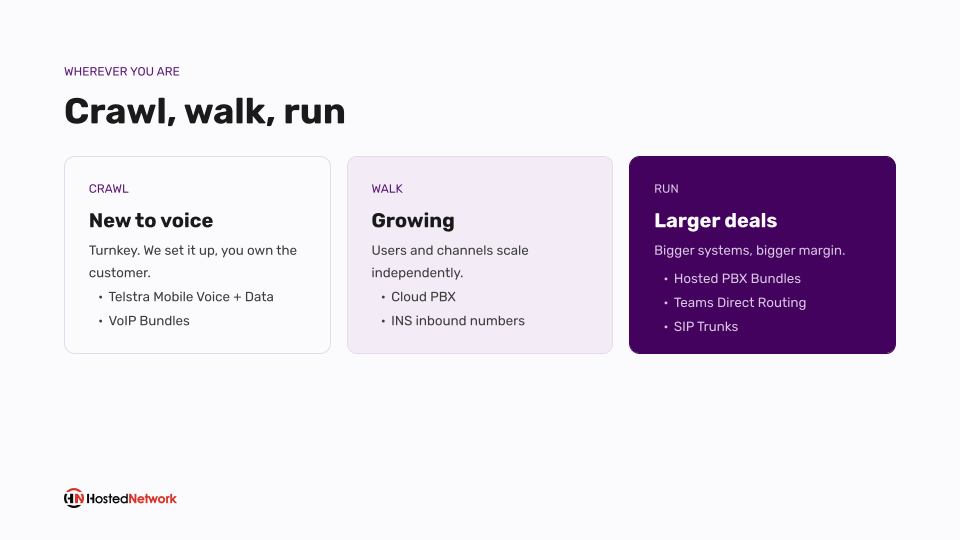
Everyone is at a different stage with every product, so the voice portfolio is built to meet you wherever you are.
Crawl: new to voice. Start turnkey. Telstra Mobile Voice + Data is the simplest entry point. It’s a SIM on Telstra’s network, managed entirely through the Partner Portal, and even with your margin on top you can beat Telstra’s retail pricing. What customers are really buying is not having to deal with Telstra themselves. VoIP Bundles do the same job for the desk: choose the handset, tell us how many, and it’s one price per user per month with everything included and fully managed.
Walk: growing. Cloud PBX is the middle ground. Users and channels are priced separately, so it grows with the customer, and you take on more control (and more margin) as you go. INS, our inbound number system for 1300, 1800 and premium numbers, sits here too and runs off-net, which gives you disaster recovery if a main phone system goes down.
Run: larger deals. Hosted PBX Bundles give a single customer a dedicated phone system, from a small office up to a hotel with thousands of users and full high availability. We offer both Yeastar and 3CX because most MSPs already have a flavour their team is trained on, and we’d rather you keep that investment than retrain. Teams Direct Routing is for customers who live in Microsoft Teams and want calling inside it. SIP Trunks connect a PBX the customer already owns.
Everything can be ordered self-service through the portal, or you can bring us the opportunity and we’ll help you quote it.
The margin lives beyond the PBX
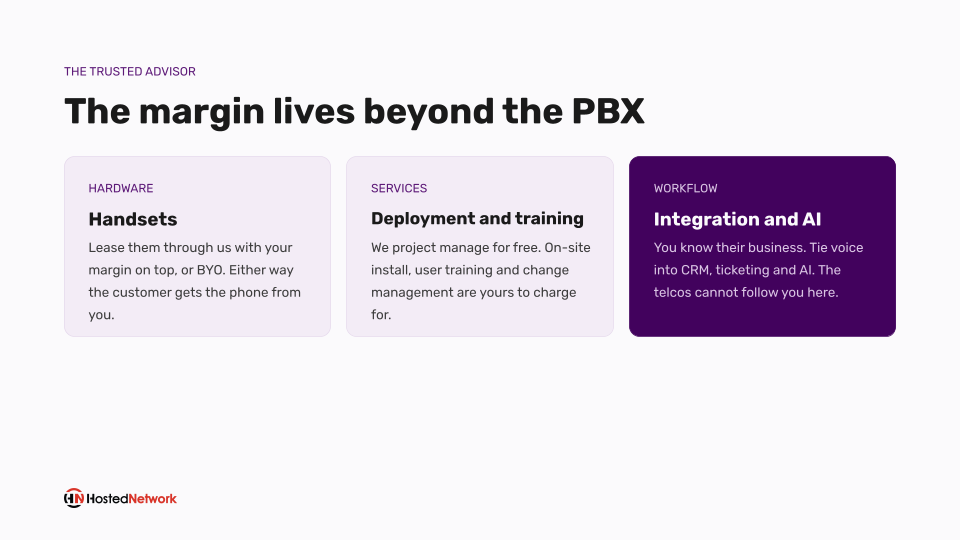
This is where we see partners leave the most money behind. The phone system is the start of the margin, not the end of it.
Handsets. Lease them through us with your margin on top, and hardware becomes recurring revenue instead of a one-off sale. We carry the warranty and the risk. When the handsets reach end of life, you either refresh them or keep billing. BYO and outright purchase are available, but hardware-as-a-service is the play.
Deployment and training. We project manage every managed deployment at no charge. What we don’t do is put the phones on desks or train the users. That’s your work, and you should be charging for it. The project fee, the onsite install and the change management add up to a far larger share of the deal than most partners take, and it’s the item we see missed most often.
Integration and AI. You understand the customer’s business. A telco never will. Tying voice into their CRM, their ticketing and the AI modules now available on both 3CX and Yeastar is where the real differentiation sits. One of our partners has already productised this into a turnkey solution for tradies so they never miss an appointment call. If your MSP is running AI projects, voice slots straight into them, and the telcos can’t follow you there.
Switching is painless
If you already sell voice but have customers sitting with another provider, the biggest objection to moving is the pain of moving. We’ve removed it.
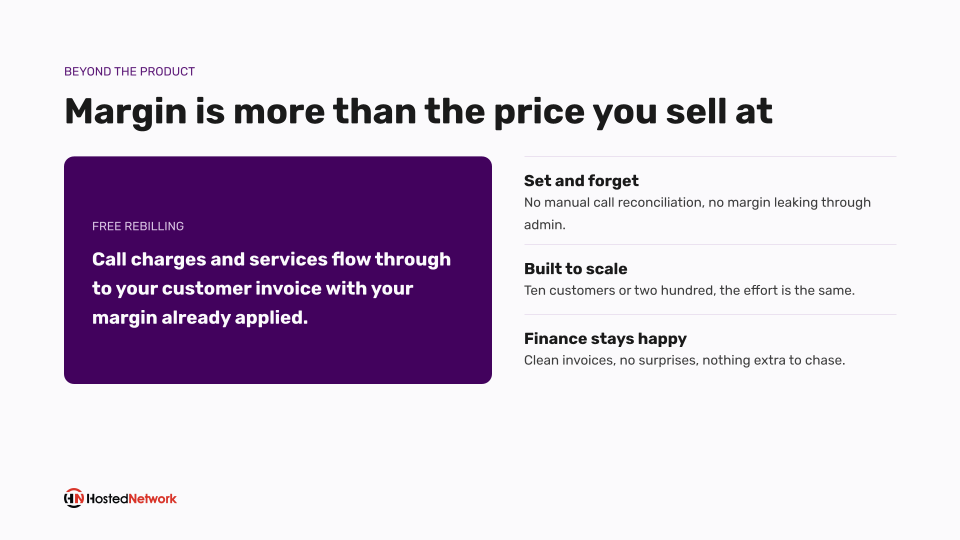
Number porting is free on every product and has been for years. Solution design, build and deployment are available on everything we sell, so a switch doesn’t become a project you have to resource yourself. And rebilling means the ongoing admin is handled from day one.
Margin doesn’t usually burn on the quote. It burns on all the other touchpoints: porting, design, billing. Take those costs out and once a deal is sold and set up, it’s set and forget.
Margin is more than the price you sell at
If you’ve done voice before, you know porting is the one thing that can go wrong. We’d like to think we do it better than any other telco in the industry, because we approach it with an MSP mindset. That’s how we started, and it’s how the team still thinks.
You submit one form in the Partner Portal with proof the customer owns the numbers, usually a bill from the losing carrier. From there we run it as a project, not an order. We qualify everything on our side first, including the gotchas that get ports rejected, like a block of 500 numbers that turns out to sit with three different upstream carriers. You might get the odd question. That’s it.
When it’s ready, we come to you to book a cutover window that suits the customer, rather than dictating one. Temporary numbers keep calls landing if it runs long. A single number typically takes about seven days. Complex multi-number ports can run 30 to 45 business days, and for a large migration we’ll hold a weekly project meeting with you, at no charge, until it’s done.
Your part is setting the customer’s expectations. Porting involves a losing carrier we don’t control, and while delays are rare, they happen. If nobody has told the customer what to expect, you’re the one with egg on your face. To help, we’ve written a customer-facing guide, Number Porting Made Simple. It’s free in the Partner Portal, and we’ll white-label it with your branding on request.
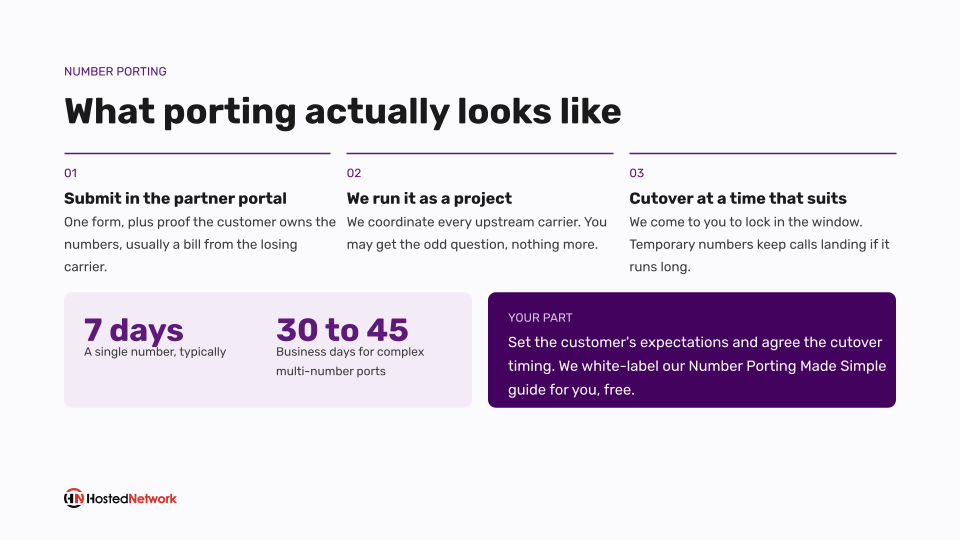
What porting actually looks like
If you’ve done voice before, you know porting is the one thing that can go wrong. We’d like to think we do it better than any other telco in the industry, because we approach it with an MSP mindset. That’s how we started, and it’s how the team still thinks.
You submit one form in the Partner Portal with proof the customer owns the numbers, usually a bill from the losing carrier. From there we run it as a project, not an order. We qualify everything on our side first, including the gotchas that get ports rejected, like a block of 500 numbers that turns out to sit with three different upstream carriers. You might get the odd question. That’s it.
When it’s ready, we come to you to book a cutover window that suits the customer, rather than dictating one. Temporary numbers keep calls landing if it runs long. A single number typically takes about seven days. Complex multi-number ports can run 30 to 45 business days, and for a large migration we’ll hold a weekly project meeting with you, at no charge, until it’s done.
Your part is setting the customer’s expectations. Porting involves a losing carrier we don’t control, and while delays are rare, they happen. If nobody has told the customer what to expect, you’re the one with egg on your face. To help, we’ve written a customer-facing guide, Number Porting Made Simple. It’s free in the Partner Portal, and we’ll white-label it with your branding on request.
How to get started on voice
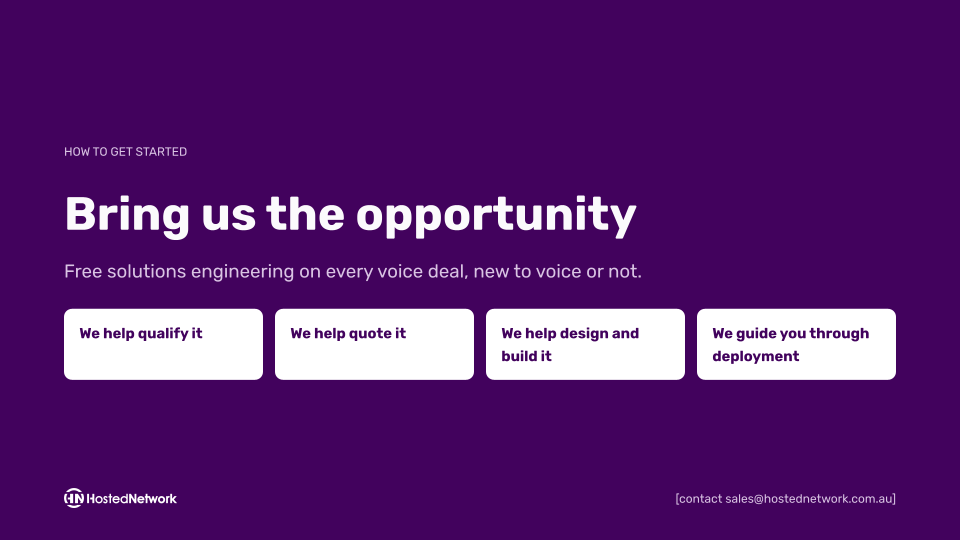
New to voice or a seasoned veteran, the offer is the same: bring us the opportunity. Solutions engineering is free on every voice deal.
We’ll help you qualify it, with discovery questions to ask and a form that captures call flows, queues and IVRs. We’ll help you quote it and build the bill of materials, so you know what we provide and what’s yours to add on top. We’ll help design it, and if you choose a managed product we’ll build it: tell us the call flows and the users, and it’s set up for you. Then we’ll guide you through deployment and project manage the larger cutovers alongside you.
If you’re more experienced, everything is available unmanaged. Think of it as buying the raw ingredients or buying the finished cake.
We don’t stop at the sale. Our voice support team receives more partner testimonials than any other team in the business, and that’s not an accident. Voice is something we’ve done for a long time, and we’re very good at it.
So here’s the challenge. If you’re not doing voice, you should be considering it. It’s revenue sitting inside customers you already have. Crawl before you walk, walk before you run. Start with something turnkey, and lean on us for the rest.
Talk to your account manager, drop us a note through the Partner Portal, or email sales@hostednetwork.com.au and we’ll walk you through either one.