 Contact us
  Partner Login
  Service Status

 April 21, 2026
 Jessie Carpio
 6 minutes
If you’re an MSP quoting standalone nbn services, you’re playing a game you can’t win. The price is public, the customer knows it, and the moment the conversation becomes about megabits and monthly cost, the only direction it goes is down.
Bundle It. And Make the Bundle Yours.
The answer to commodity pricing isn’t to fight on price. It’s to stop being comparable.
A bundled managed connectivity solution (internet connection, UTM firewall, failover and monitoring wrapped into a single managed service) can’t be directly compared to a retail telco quote. The retail telco is selling a pipe. You’re selling the outcome of that pipe working reliably, securely and with full support coverage baked in.
The key is standardisation. Not dozens of configurations. Two or three clear tiers. Good, better, best. Aligned to client size and risk profile:
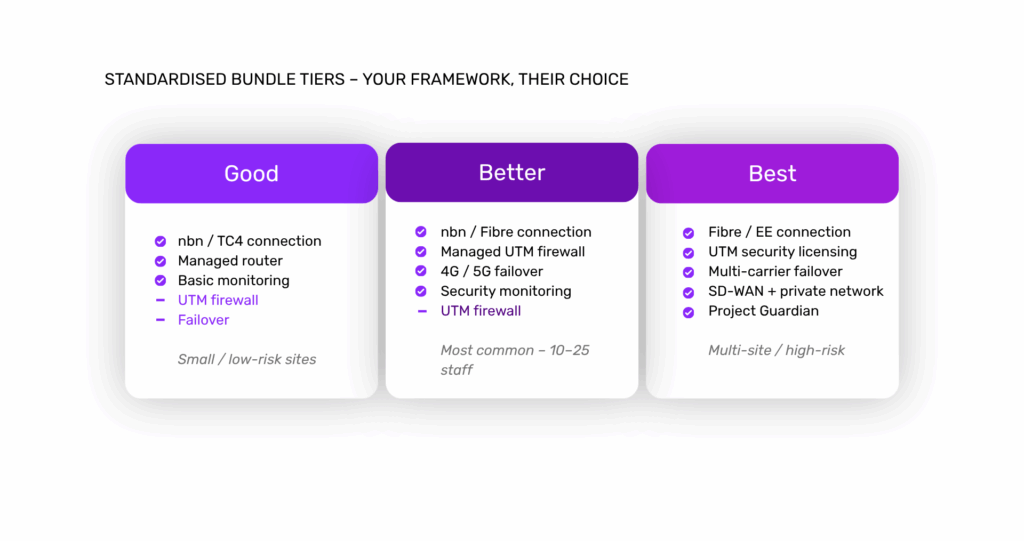
The customer chooses within your framework. You define what’s in each tier. That framework is yours, and a solution built around it isn’t something a customer can replace based on a retail price comparison.
The key principle: a bundled solution isn’t directly comparable to a retail telco quote. That’s the entire point of bundling.
Standardise Your Hardware for Margin, Not Just Sales
Many managed service providers (MSPs) understand the sales case for standardisation. Fewer appreciate the operational one.
When your team is supporting five different firewall vendors across your client base, every support interaction becomes a context-switch. Here’s what that actually costs you:
- A technician picking up a fault ticket on a device they haven’t touched in three months isn’t going to resolve it quickly.
- Time to resolution blows out, and that time comes straight off your margin.
- If internet support is bundled into your managed services agreement (MSA), which it often is, every slow resolution burns engineer time you aren’t being paid for.
- Multiply that across your client base and the margin loss is significant.
Pick a firewall vendor. Fortinet and Juniper are both strong options with good partner programmes. Then build your support capability around it. Apply the same good/better/best logic to hardware selection that you apply to your bundle tiers.
Remember: standardisation isn’t a sales strategy. It’s a margin protection strategy.
Always Quote a UTM. Not a Basic Router.
This is the one that makes some MSPs uncomfortable, because it requires quoting something more expensive and trusting that the customer will see the value. The instinct to default to a basic router, to keep the price down, to avoid the objection, is understandable. But it’s the wrong call, for two reasons.
1. You’re underselling the solution. A UTM (Unified Threat Management) firewall isn’t a premium add-on. It’s the right answer. Quoting a basic router positions connectivity as a utility. Quoting a UTM positions it as managed infrastructure with security built in.
2. You may be putting yourself at risk. If you quote a basic router to save the customer money and something goes wrong (a breach, a compliance issue, a security incident that a UTM would have flagged), you may find yourself in a very difficult position, contractually and reputationally.
Important: document that you recommended the right solution. Let the customer say no if they choose to. That’s a fundamentally different position to never having raised it, and it protects you either way.
Hosted Network can supply routers as a rental option, which removes the capital outlay concern entirely. The MSP doesn’t need to carry the hardware cost. You apply margin to the rental, and the customer gets enterprise-grade equipment without a large upfront spend. The objection disappears before it’s raised.
Failover Must Use a Different Technology Medium
This is one of the most common mistakes in connectivity design, and a straightforward one to make if you’re not thinking about how failures actually happen.
The instinct is to add a second nbn TC4 service as failover. It feels logical. But this misunderstands the failure mode entirely.
The conversation to have with clients isn’t “do you want failover?” It’s “what happens to your business when your primary connection goes down?” Once they answer that honestly, the case for a properly designed failover solution makes itself.
Make It Mandatory. In the Agreement, Not Just the Conversation.
The most mature MSPs don’t treat the standardised solution stack as an optional add-on. They build it into the managed services agreement as a requirement. Here’s why that matters.
- It removes the negotiation. When the stack is standard rather than optional, there’s no conversation about whether the client wants to include the UTM this time or skip the failover to save money. The decision has already been made.
- It protects the client. A managed services agreement that doesn’t include proper edge security and failover isn’t delivering what it promises. Making the stack mandatory is the right thing to do for the businesses depending on you.
- It protects you. When something goes wrong, and eventually something always goes wrong, you’re in a very different position if the client’s environment is built to your standard, not a compromised version they chose to save money on.
The standard stack, non-negotiable: UTM firewall. Failover connection. MSP-supplied router. Written into the MSA. Not optional. Not negotiated. When it’s standard practice, the conversation never becomes a negotiation.
The Bottom Line
Standalone internet competes on price because there’s nothing else to compete on. The moment you bundle, standardise and embed connectivity into a managed agreement, you’re no longer in that market.
You’re selling something the retail telco can’t replicate: a solution designed for that client’s environment, integrated with their security stack, supported by a team that knows their infrastructure and backed by a managed agreement that holds everyone accountable for outcomes.
That’s not a commodity. And it shouldn’t be priced like one.
Questions We Get a Lot
How should an MSP price nbn?
Don’t quote it standalone. Price nbn inside a managed connectivity bundle (UTM, failover, monitoring) so the customer can’t put it side-by-side with a retail telco quote. The moment it’s bundled, the comparison breaks.
Should I use a second nbn service as failover?
No. If the primary goes down for a network reason, a second nbn service on the same path often goes with it. Failover only works if it’s on a different medium.
What about clients who just want the cheapest option?
Quote the UTM anyway and let them say no in writing. Document that you recommended it. If they opt out and something goes wrong later, you’re in a very different position than if you never raised it.
Want the Full Playbook?
This article is drawn from our MSP Playbook for Connectivity, a practical guide to protecting margin, differentiating your offering and owning the connectivity layer in your client relationships.
Read the full playbook